

Artificial intelligence in Atlanta, Georgia is at a turning point. Companies like NCR and Georgia Tech are using advanced AI systems. The real question is how to control these systems.
A protocol-first approach lowers risks and matches innovation with community needs.
This article talks about Artificial Intelligence Protocol Architecture in Atlanta, Georgia. It shows why starting with protocols is key for AI in services, healthcare, and business. Protocols define rules for identity, decision-making, tracking, and infrastructure, making AI safe and expandable.
It offers a clear path for tech leaders, city planners, researchers, and vendors. We discuss governance, infrastructure, identity, and culture, like the Spates Legacy Art Collection. These elements shape public trust and technical strength.
We stress the importance of protocols before autonomy. We also suggest the AI Origin Series for more on framework and implementation in Atlanta’s AI scene.
Key Takeaways
- Protocol-first approaches make artificial intelligence atlanta georgia deployments safer and more accountable.
- Artificial Intelligence Protocol Architecture Atlanta Georgia provides a blueprint for identity, governance, and infrastructure.
- Prioritizing protocol before autonomy enables scalable innovation across public and private sectors.
- Local research, industry, and cultural institutions influence how protocols are adopted and trusted.
- Use the AI Origin Series as a strategic reference for implementing protocol-centric AI designs.
The Case for Protocol-First Design in Atlanta’s AI Ecosystem

Urban AI projects have a big decision to make. They can either start with strict rules or give models more freedom and add safety later. Atlanta’s experts believe starting with clear rules leads to better results.
They say starting with a protocol-first design is key. This means setting up governance, control planes, and identity systems first. This way, projects meet legal and ethical standards from the start.
Defining protocol-first versus autonomy-first approaches
Protocol-first systems have clear rules and controls before they start making decisions. This way, how agents interact and what data flows are allowed are set from the start.
Autonomy-first systems give models more freedom and add rules later. This approach speeds up testing but can be risky in real-world use.
How Atlanta Georgia artificial intelligence leaders view protocol priority
Experts at Georgia Tech and Emory University focus on clear interfaces and identity systems. They use these in city and healthcare projects. Startups and big IT groups also follow this approach when planning.
They see artificial intelligence protocol architecture as a way to make things easier. It helps with city projects, reduces risks, and speeds up the use of AI in public services.
Benefits for AI innovation Atlanta Georgia and technology ecosystem Atlanta
Protocol-first design brings big benefits to Atlanta. It makes integration faster and cheaper for city agencies. It also helps with legal issues and makes investors more confident.
- Faster municipal and enterprise deployment through standardized interfaces
- Reduced liability via enforced identity and audit mechanisms
- Simpler procurement and clearer integration paths for vendors
- Stronger collaboration across academia, startups, and corporations in the technology ecosystem Atlanta
These advantages help Atlanta’s AI innovation grow. By starting with protocols, projects can use autonomy safely in areas like transportation and health.
Artificial Intelligence Protocol Architecture Atlanta Georgia

In Atlanta, building strong systems means having clear rules for how things work. Experts at Emory University, Georgia Tech, and local companies use these rules. They help connect models, devices, and people’s work together.
This way, everyone knows what to expect in public projects and private ones too.
Core components of protocol architecture in local AI systems
Trust starts with identity and authentication layers. Role-based access and secure agent registries keep things in check. Decision kernels are small but powerful, making sure things happen right.
Control planes manage commands and data flow. Audit trails keep track of what happens, for checking later.
Schema and messaging standards, like APIs, help different parts work together. Data governance and safety policies make sure everything runs smoothly and safely.
How protocol design affects AI infrastructure Atlanta Georgia
Choosing protocols affects how we use hardware and networks. Tight coupling means faster data, but edge compute is better for logistics. Loose coupling is good for fintech, with central GPU farms.
These choices impact costs and how well systems work. Data rules shape storage and streaming for health and supply chain apps. Strong security and audits mean we need secure enclaves and encrypted networks.
Good protocol design makes systems more reliable and faster to recover from problems.
Linking to the AI Origin Series pillar page for deeper framework context
Practical tools make protocol work clear. Telemetry, policy engines, and access lists are reusable. Secure registries and message contracts help startups and big companies work together in Atlanta.
For more on this, check out the AI Origin Series. It has diagrams and the Core-001 kernel concept. It shows how protocol artifacts lead to operational controls and design patterns in Atlanta’s AI projects.
Historical context: Atlanta’s evolution in artificial intelligence development

Atlanta’s AI journey started in schools and labs. At Georgia Tech’s College of Computing, early work focused on machine learning and robotics. Emory University added clinical informatics and biomedical data science, linking research to patient care.
Government agencies like DARPA and NSF funded these projects. This support helped seed long-term AI research in Atlanta.
Leaders and research groups set high standards. Georgia Tech’s research centers provided open datasets and toolkits. Emory’s data science labs applied algorithms to healthcare, creating workflows.
These efforts built talent pipelines and framed real-world problems for AI development in Atlanta.
Industry soon adopted these research findings. Telecommunications companies used predictive analytics for network improvement. Logistics and supply-chain firms tested computer vision for sorting and planning routes.
Healthcare providers worked with university labs to implement clinical decision support. This move accelerated AI in healthcare settings in Atlanta.
Startup incubators and accelerators turned prototypes into products. Atlanta Tech Village and the Advanced Technology Development Center offered mentorship and resources. Seed and venture funding helped early commercial deployments and staff growth in the AI industry in Atlanta.
Local companies and system integrators refined their practices. IT teams in finance and enterprise software adopted governance models and testing frameworks. This shift led to robust architectures and clear protocols as systems grew, reflecting the region’s research roots.
The journey from academic labs to production systems explains Atlanta’s current AI momentum. Strong universities, federal research ties, active incubators, and industry adoption created a supportive ecosystem. This ecosystem fuels ongoing growth in AI research and development in Atlanta.
Governance layers and intelligence control in urban AI deployments
Managing city-scale AI needs clear roles and strong safeguards. In Atlanta, many groups work together on AI governance. These include city IT teams, state regulators, and universities like Georgia Tech and Emory. Also, companies like Delta and UPS, and standards bodies like NIST play a role.
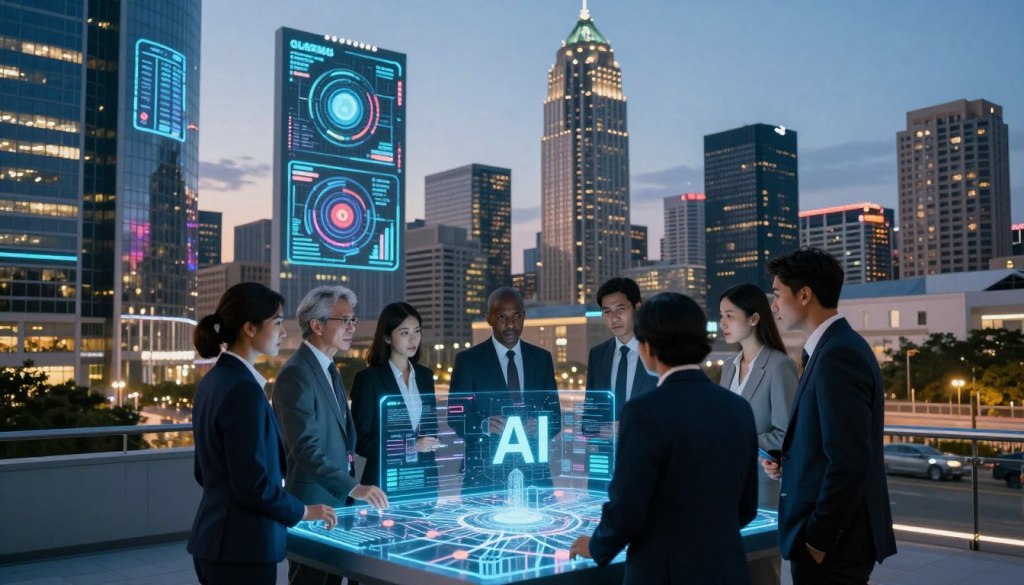
City IT teams manage smart traffic and public safety systems. State regulators ensure privacy and procurement rules are followed. Universities review AI ethics in pilot programs. Companies check vendor contracts for compliance.
The decision kernel metaphor is used to describe a central control core. It takes in sensor data, applies rules, and decides actions. This metaphor helps in understanding the core of AI control.
The kernel acts as a strict policy enforcer. It makes key decisions, follows rules, and keeps records. This makes audits easier and helps explain AI actions to city officials and lawyers.
Accountability is key with AI. It relies on logs, access controls, and regular reports. Logs must show decisions, time stamps, and policy versions used.
Following laws and standards is important. Records must support legal requests and internal checks without revealing too much.
Urban AI needs governance built into its systems. Controls are placed at network edges, in centers, and in the cloud. They manage risks in smart lighting, transit, and safety analytics.
Controls allow for testing new features safely. This keeps critical systems stable. It also limits damage if AI acts unexpectedly.
Good AI governance means clear roles, a solid decision kernel, and strict accountability. These steps help Atlanta build trust as it grows its smart city projects.
AI infrastructure design versus generative model focus

Production AI needs strong platforms more than any model. In city-scale use, storage, orchestration, and data pipelines keep services running. This highlights the debate between infrastructure and generative models for Atlanta teams.
Why infrastructure matters more than standalone models in production systems
Generative models get attention for their visible outputs. But, healthcare and logistics focus on end-to-end reliability. A model that works in a lab can fail in production without proper monitoring.
Teams focus on SRE practices and disaster recovery plans. These steps reduce downtime and protect sensitive data. They ensure AI systems in Atlanta work well.
AI system architecture Atlanta Georgia: hardware, networking, and data flow
A typical stack starts with edge sensors and IoT devices. Data goes to secure data lakes and then to GPU clusters. Message brokers and networks carry data and model outputs.
Kubernetes manages deployments and updates. Observability layers track performance with traces and logs. This helps teams monitor AI systems in Atlanta.
Case examples from Atlanta Georgia artificial intelligence solutions
In Atlanta hospitals, AI flags risk scores in EHR systems. The real value is in data pipelines and access controls. These ensure compliance under heavy loads.
Logistics firms use sensor streams and compute clusters for route optimization. Their success comes from reliable data ingestion and model serving. This is more important than any single model.
Municipal sensor networks for traffic and air quality use local nodes and edge inference. This design makes infrastructure more important than models for long-term service in Atlanta.
The operational picture includes chaos engineering and capacity planning. Observability, SLOs, and protocol-first deployments keep AI systems healthy. This is key for real-world conditions in Atlanta.
Autonomy hierarchy and structured intelligence frameworks
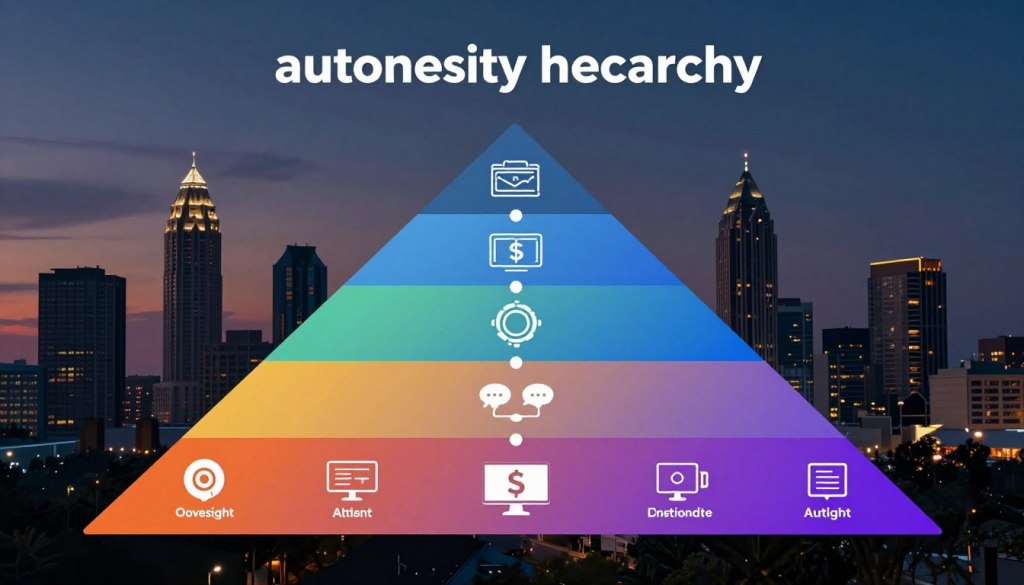
Clear tiers help manage machine behavior in organizations. A practical autonomy hierarchy separates levels of machine control. It supports predictable rollouts and aligns with AI strategies in Atlanta, Georgia.
Defining autonomy tiers and permitted behaviors
Tiers should be clear and defined. Tier 0–1 requires human approval for critical actions. Tier 2–3 has fixed capabilities and time limits. Tier 4+ has strict controls and governance.
Each tier outlines what machines can do, safe modes, and when humans must step in.
How protocols enforce hierarchy in decision-making
Protocols use policy engines and signed commands to enforce rules. They check requests against rules before action. Signed commands and logs prevent unauthorized actions.
Simulated approval workflows test higher tiers safely.
Implications for artificial intelligence systems atlanta georgia
Atlanta teams match local needs to tier levels. Tasks like traffic control and financial risk scoring need different levels of autonomy. This approach lets organizations expand automation safely.
Documenting allowed actions and safe modes is key. This ensures technical design aligns with broader intelligence frameworks. It supports a strong AI posture in Atlanta, Georgia.
Identity architecture and authentication in protocol-centric AI
The identity layer is key to trust in AI systems. It helps teams understand who or what is acting, where keys are stored, and how audits are done. This setup is vital for secure operations in Atlanta, both in cities and companies.

Identity layers for agents and users within AI ecosystems
Design identities in layers: humans, service accounts, agents, and devices. Each layer has different rights and lifespans. Use PKI, hardware keys, and SAML and OIDC to lower impersonation risks.
Service accounts should use short-lived tokens. Agents need crypto links to their runtimes and audit trails for their actions.
Identity architecture’s role in security and governance
Strong identity architecture ensures precise control, proof of actions, and audit trails. It shows who did what and when. This meets rules from regulators and the AI authority in Atlanta.
Use detailed roles, access control, and unchangeable logs for clear investigations. Rotate tokens, manage secrets, and require attestations for key actions. This boosts security.
Integration with city and enterprise identity systems in Atlanta
Integrate enterprise systems like Okta with city credentials. Use federation and trust anchors for secure cross-organization work. This keeps systems working together smoothly.
Make sure identities are tied to decision-making systems. Use hardware for edge devices and match identity lifecycles with token policies.
| Identity Tier | Authentication Mechanism | Recommended Controls | Primary Benefit |
|---|---|---|---|
| Human users | SAML / OIDC via Okta or Azure AD | Multi-factor auth, short sessions, attribute-based roles | Clear accountability and ease of federation |
| Service accounts | Scoped OAuth tokens, client certificates | Least privilege, automatic rotation, dedicated vaults | Reduced blast radius for compromised credentials |
| Autonomous agents | Hardware-backed keys, signed attestations | Identity binding to decision kernels, immutable logs | Traceable agent actions and protocol enforcement |
| Edge devices | TPM-backed certificates and device attestation | Periodic re-attestation, firmware integrity checks | Trusted signals from distributed endpoints |
Align identity architecture with AI design in Atlanta. Work with the AI authority and IT to make secure, auditable services. This keeps privacy and allows for quick action.
Control systems and the AI motherboard symbolism
The AI motherboard symbolism is a way to visualize a central system. It connects protocols, agents, and policies together. This image makes complex control systems easier to understand and discuss.
Metaphor of the AI motherboard for centralized protocol logic
Imagine the motherboard as the core of protocol logic. Protocol engines, orchestration lanes, and policy repositories connect through common paths. This setup makes it easier to manage dependencies and changes in ai protocol architecture atlanta georgia.
Physical and logical control planes in ai protocol architecture atlanta georgia
The physical control plane deals with hardware. It includes switches, dedicated management NICs, and out-of-band consoles. This part ensures direct control over devices and their states.
The logical control plane handles policy engines, rule interpreters, and orchestration tools. It turns governance into runtime decisions and shows APIs for agents to request permissions.
When the physical and logical control planes work well together, operators get fast telemetry and flexible policy enforcement. This is key for resilient systems in Atlanta data centers and city-edge systems.
Engineering trade-offs for resilient control systems
Designers face a choice between latency and centralization. A centralized policy store makes things consistent but can slow down time-sensitive tasks.
They also decide between a single point of failure and distributed control. Full distribution boosts availability but makes things more complex.
Consistency versus availability is another big choice. Caching rules, replication frequency, and quorum choices all play a part. Hybrid topologies often find a good balance, with centralized policy definitions and local enforcement.
Good practices for resilience include hardware redundancy, multi-zone failover, and secure boot on control nodes. Frequent chaos testing and automated recovery plans also help reduce downtime for complex systems.
| Aspect | Centralized Model | Distributed Model | Hybrid Guidance |
|---|---|---|---|
| Latency | Higher for remote agents | Lower, local decisions | Cache policies; local fast-paths |
| Consistency | Strong, single source | Eventual across nodes | Central policy, local enforcement |
| Availability | Lower if central fails | Higher with node redundancy | Multi-zone replication, failover |
| Security | Concentrated hardening needed | Surface area increases | Immutable images, secure boot |
| Operational Complexity | Simpler policies, harder scaling | Complex sync and debugging | Orchestration tools, observability |
| Use Case Fit | Policy-heavy governance | Low-latency edge control | City-wide services, enterprise hybrids |
AI Origin Core-001 and the role of foundational kernels
The AI Origin Core-001 is a small, trusted system that handles identity, policy, and logging. It’s a blueprint for teams in Atlanta and worldwide to build secure systems. It’s seen as a basic, safe foundation for other services to check against.
AI Origin Core-001 Atlanta Georgia is growing thanks to partnerships with Georgia Tech. These partnerships test how kernels manage model outputs and keep systems safe. They use libraries or special hardware to improve security.
The kernel’s job is to keep model responses safe and in check. It limits what models can do and keeps systems stable. This makes it easier for organizations to stay safe while allowing for innovation.
How teams use the kernel varies. Small groups might add it as microservices. Bigger teams might use special appliances or secure areas. The goal is to keep systems safe without stopping new ideas.
The AI Origin Series helps teams in Atlanta. It offers tools and research to match local work with the kernel’s role. Georgia Tech and local companies use this to guide their projects.
| Aspect | Core-001 Role | Typical Implementation |
|---|---|---|
| Identity | Authoritative agent and user binding | Token service integrated with enterprise identity providers |
| Policy Enforcement | Runtime checks for permitted actions | Policy engine exposed as microservice or library |
| Audit Logging | Immutable records of decisions and actions | Append-only logs stored in secure, tamper-evident systems |
| Deterministic Decisions | Orchestration of safe, reproducible outputs | Deterministic workflow engines or hardware-assisted determinism |
| Safety Invariants | Enforce constraints across model layers | Runtime guards and fail-safe policies |
| Deployment Pattern | Minimal trusted computing base | Library, microservice cluster, or secure enclave |
Spates Legacy Art Collection, Ron Spates, and cultural intersections
The Spates Legacy Art Collection is a meeting point for creativity and technology in Atlanta. It brings together curators and tech experts to explore new ways to display art. They use artificial intelligence to help with organizing, checking art history, and creating interactive displays.
Local teams are working together to find new ways to understand the collection. They use computer vision to tag art, natural language models for captions, and systems to plan tours. This creates a dynamic archive that combines human knowledge with technology.
Ron Spates has greatly influenced Atlanta’s cultural scene through his collecting and programs. His leadership encourages discussions on the use of new technologies in museums. This makes ron spates artificial intelligence atlanta georgia a topic for the whole community to discuss.
Exhibitions make AI understandable for everyone. They show how algorithms work and the steps they take. This helps people see the stories behind the technology.
Art projects also help with planning for AI in cities. Museums test systems that are open and fair. This helps in finding ways to make sure AI is used responsibly.
By working together, Atlanta is setting standards for using data and technology. This collaboration helps in making decisions about AI. It turns museums into places to test and learn about ethical AI.
AI engineering and system architecture philosophy in Atlanta
In Atlanta, AI teams aim for a balance. They use systems that grow from small tests to big projects. This keeps things safe and traceable. Here, we talk about how to build systems that follow rules first in Atlanta’s tech world.
Principles for building protocol-first artificial intelligence architecture atlanta georgia
Design small, simple modules that can work together. This makes systems more flexible.
Least privilege: Give agents and services only what they need. This lowers risks and makes audits easier.
Always have logging and traceability on by default. This helps with following rules and solving problems.
Let systems get new abilities in steps. This way, they can learn and grow safely.
Make sure every action is tied to an identity. This makes it clear what’s happening.
Use the platform layer to set rules. This way, new projects follow the rules automatically.
AI engineering Atlanta Georgia: teams, skills, and organizational structures
Teams with different skills are key to making strong systems. You’ll need architects, engineers, security experts, and more.
Local schools, like Georgia Tech, help by training skilled workers. They bring the needed skills to the teams.
Good teams have a shared platform team and a governance board. They also have a process for making changes. This ensures everything is safe and follows rules.
AI framework design Atlanta Georgia: standards and best practices
Test policies to make sure they work as planned. Use formal checks when you can.
Keep an eye on systems and check rules at runtime. This catches problems early. Follow standards from IEEE and NIST to make systems work better together.
Help developers by giving them tools and clear rules. This way, they can use what’s already made instead of starting from scratch.
| Focus Area | Practical Action | Expected Benefit |
|---|---|---|
| Protocol composability | Publish reusable protocol modules and catalogs for teams | Faster integration, fewer security faults |
| Least privilege | Automate role-based policies and short-lived credentials | Reduced attack surface, clearer audits |
| Auditable defaults | Enable default logging, versioned configs, immutable artifacts | Simpler compliance and root-cause analysis |
| Progressive autonomy | Gate advanced behaviors with staged rollout and review | Controlled learning, safer deployments |
| Identity-first design | Integrate enterprise identity and context-aware tokens | Traceable intent, improved governance |
| Infrastructure-as-policy | Encode policies in CI/CD pipelines and platform templates | Consistent enforcement, faster audits |
By following these steps, Atlanta is set for success in AI. It connects research, industry, and public groups. Clear rules help teams work together and lead to safe innovation. Atlanta’s focus on strong AI systems meets both technical and civic needs.
Decision kernel and circuit intelligence pathways
The decision kernel metaphor is a small runtime that checks inputs against rules and policies. It then only allows certain actions. This way, it keeps a record of all actions taken, helping teams understand why certain actions were chosen.
Modeling decision kernels as constrained policy executors
The kernel acts like a gate, checking sensor data and applying rules. It also picks fallback actions when needed. It logs important information to make the decision-making process clear and traceable.
Circuit intelligence pathways: mapping signal flow for explainability
Circuit intelligence pathways show how data moves through a system. Each step is checked, making it easy to find and fix problems. This makes complex systems easier to understand and review.
How protocols shape pathway design and runtime behavior
Protocols define what actions are allowed and when to use fallbacks. They guide how the system works and what it can do. This ensures the system behaves in a predictable and traceable way.
Best practices include using standard logs and tracing tools. This helps everyone understand the system’s decisions without seeing too much detail.
Emerging leadership, research culture, and AI innovation in Atlanta
Atlanta’s AI scene is buzzing with university labs, startups, and corporate teams. They work together on systems that focus on protocols first. Leaders at Georgia Tech, Emory University, and Emory Healthcare lead projects that focus on making results reproducible and governed. They also move models into real-world systems.
The area is led by figures like Zsolt Kira and Tim Oates at Georgia Tech. They work with technical executives in healthcare and finance. These leaders use protocol-first practices to manage risks and grow. They also mentor startups and help with municipal pilots.
Academic and industry ties boost AI research in Atlanta. Joint labs, shared compute clusters, and student co-op programs are key. Georgia Tech, Emory, and Children’s Healthcare of Atlanta work together. They create reproducible pipelines and pilot deployments that follow clear protocol layers.
Funding and incubator support fuel AI innovation in Atlanta. The Advanced Technology Development Center (ATDC), TechSquare Labs, and venture firms like BIP Capital help. They provide capital, workspace, and mentorship for teams building protocol-centric infrastructure.
State and federal grants add to private investment, supporting applied research and data-sharing agreements. Corporate innovation labs at Delta and The Home Depot offer engineering resources and production testbeds. This speeds up the development of product-ready systems.
The AI ecosystem in Atlanta now values rules, audits, and operational controls. This approach helps make deployments safer and easier to govern. It’s a big change for hospitals, banks, and city projects.
Below is a compact comparison of key ecosystem players, their roles, and the resources they supply to emerging teams in Atlanta.
| Organization | Primary Role | Resources Provided | Typical Beneficiaries |
|---|---|---|---|
| Georgia Tech | Research and talent pipeline | Lab partnerships, compute clusters, graduate students | Startups, hospitals, enterprise R&D |
| Emory University & Emory Healthcare | Clinical research and applied trials | Clinical data access, IRB frameworks, translational teams | Health tech startups, medical AI research |
| ATDC | Incubator and startup acceleration | Mentorship, office space, investor introductions | Early-stage AI startups |
| TechSquare Labs | Startup studio and corporate partnerships | Prototyping support, corporate pilots, networking events | Scaleups, corporate innovation teams |
| BIP Capital and local VCs | Venture funding | Seed to growth capital, board-level guidance | Product teams, infrastructure startups |
| Corporate labs (Delta, The Home Depot) | Production testbeds | Data partnerships, engineering resources, pilot programs | Enterprise integrations, supply chain AI |
Conclusion
Protocol before autonomy leads to safer and more reliable AI systems in Atlanta, Georgia. By focusing on AI protocol architecture, we can make sure AI works as expected. This approach keeps AI systems in check while allowing for new ideas in both business and education.
To move forward, we should start using kernel-based protocols like Core-001. We also need to invest in strong infrastructure and identity systems. Working together across different fields will help us make these standards a reality.
Partnerships with places like the Spates Legacy Art Collection can help build trust in AI. This is key as Atlanta looks to the future of AI.
The AI Origin Series offers detailed plans for those working on AI. Leaders in research, funding, and business must work together. This will ensure AI systems in Atlanta are open, strong, and focused on the community’s needs for years to come.
FAQ
Why must protocol design come before granting autonomy to AI systems deployed in Atlanta, Georgia?
Designing protocols first sets clear rules for AI systems. This is key in Atlanta’s civic, healthcare, and tech sectors. It lowers risks and ensures systems work well together, making AI safer to use.
What is meant by “Artificial Intelligence Protocol Architecture” in the Atlanta context?
In Atlanta, AI protocol architecture means a set of rules for AI systems. It includes identity, decision-making, and safety checks. These rules help AI systems work well in Atlanta’s unique settings.
Who in Atlanta is leading the shift toward protocol-first AI approaches?
Leaders come from both public and private sectors. Groups like Georgia Tech and Emory, along with Atlanta’s IT and healthcare teams, are leading the way. They focus on making AI systems work together smoothly.
How do protocol choices affect AI infrastructure and performance in Atlanta deployments?
The protocols used affect how data flows and how systems perform. In Atlanta, the right protocols balance speed and safety. This is important for traffic and healthcare systems.
What are decision kernels and why are they important for governance?
Decision kernels are small, safe parts of AI systems. They make sure AI acts as it should. This is key for Atlanta’s AI systems to be trustworthy and accountable.
How should identity architecture be implemented for AI agents and devices in Atlanta?
Atlanta needs a strong identity system for AI. It should use cryptography and be connected to human systems. This ensures AI systems are safe and reliable.
What governance actors influence artificial intelligence governance in Atlanta, Georgia?
Many groups shape AI rules in Atlanta. This includes the city, state, universities, and tech companies. They work together to make sure AI is safe and follows the law.
How does a protocol-first approach help accelerate AI innovation in Atlanta?
Using protocols first makes AI development easier. It helps projects work together better and makes it safer. This makes Atlanta a great place for AI innovation.
Are there practical examples of protocol artifacts organizations should adopt?
Yes, there are many useful protocols. These include ways to track data and control AI actions. They help Atlanta’s AI systems work well together.
How do control planes and the “AI motherboard” metaphor inform system design?
Control planes are like the brain of AI systems. They connect different parts and make sure everything works right. In Atlanta, this helps systems run smoothly and safely.
What role do foundational kernels such as “Core-001” play in protocol-first architectures?
Kernels are the core of AI systems. They handle identity, policy, and safety. In Atlanta, they help make AI systems reliable and easy to manage.
How can cultural institutions like the Spates Legacy Art Collection influence public understanding of AI in Atlanta?
Cultural projects show how AI can be used in a good way. They help people understand AI better. This builds trust and informs policy in Atlanta.
What teams and skills are needed to build protocol-first AI systems in Atlanta?
Building AI systems needs a team with many skills. This includes tech experts, security specialists, and managers. Atlanta has the talent to support this work.
How are autonomy tiers defined and applied to Atlanta use cases?
Autonomy tiers show how much AI can do on its own. Atlanta uses these tiers for different tasks. This ensures AI systems are safe and reliable.
Where can Atlanta stakeholders find deeper technical models and implementation patterns?
For more information, check out the AI Origin Series. It has detailed guides and examples. Atlanta’s research groups and tech programs also share useful knowledge.
Leave a Reply